In this article:
- What Does Bonding Shampoo Actually Do?
- Bonding Shampoo vs. Regular Shampoo: What Is the Difference?
- How Do You Know If You Need a Bonding Shampoo?
- How Often Should You Use Bonding Shampoo?
Key Takeaways:
- Bonding shampoo is a cleanser that carries bond-reinforcing actives at an acidic pH so it stabilizes weakened disulfide bonds inside the cortex during the wash rather than only conditioning the cuticle surface.
- It matters because every wash is an opportunity: damaged hair loses more structure through repeated cleansing with harsh surfactants than most people realize, so the cleanse step either compounds the damage or works against it.
- A moisturizing shampoo addresses how hair feels by treating dryness at the surface, while a bonding shampoo addresses how hair holds together by reinforcing structure inside the fiber, which is why dry hair and damaged hair need different cleansers.
- The sulfate-free Acidic Bonding Concentrate Shampoo cleanses at pH 4.5–5.5 using a Bonding Care Complex with Citric Acid, so it reinforces bonds without stripping the lipids that damaged hair needs.
- Use it at every wash if your hair is color-treated, lightened, relaxed, or heat-styled regularly, and skip it in favor of a moisture or scalp formula if your hair has never been processed and breaks rarely.
Quick Answer
Bonding shampoo is a cleanser formulated at acidic pH with bond-reinforcing actives that work inside the cortex while it washes, which makes it the right choice for chemically processed or heat-damaged hair and unnecessary for healthy, unprocessed hair.
Bonding shampoo sits on the shelf next to moisturizing, repairing, and strengthening shampoos, and the labels do very little to tell you which one your hair actually needs. The distinction is real, and it comes down to whether the formula works on the surface of the strand or inside it.
What Does Bonding Shampoo Actually Do?
Bonding shampoo cleanses the hair while delivering actives that reinforce weakened disulfide bonds inside the cortex and hold the cuticle closed at an acidic pH.
Two things happen at once. The surfactants lift oil and buildup, which is the job any shampoo does. Alongside that, the bond-reinforcing actives penetrate past the cuticle and stabilize the protein cross-links that chemical processing and heat have weakened.
If you want the underlying chemistry in more depth, our guide to Acidic Bonding Concentrate for damaged hair covers how the bonding system works across the full range.
The acidic pH is doing quiet structural work here too. Hair sits naturally between pH 4.5 and 5.5. Alkaline formulas swell the fiber and lift the cuticle, which is exactly the state you want to avoid on compromised hair. An acidic cleanser keeps the cuticle flat through the wash, so less moisture and protein escape while the hair is at its most vulnerable.
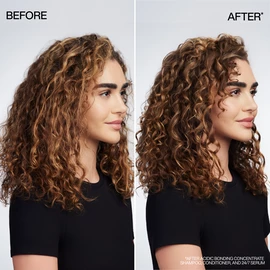
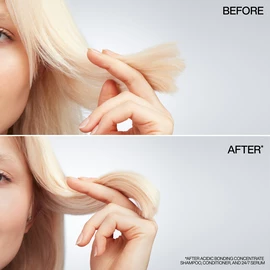
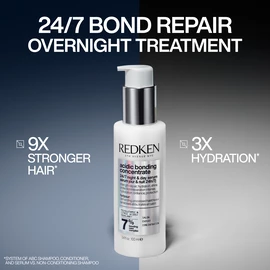
The Acidic Bonding Concentrate Shampoo is powered by a Bonding Care Complex with Citric Acid, which penetrates the cuticle to capture metal ions and reinforce weakened bonds, so your hair gets structural support at the one point in the routine it would normally lose ground. Paired with the Acidic Bonding Concentrate Conditioner, the system delivers up to 2x less breakage*, 9x smoother hair*, and 89% easier detangling*.
*Acidic Bonding Concentrate Shampoo & Conditioner vs. non-conditioning shampoo.
Bonding Shampoo vs. Regular Shampoo: What Is the Difference?
The difference between bonding shampoo and regular shampoo is depth of action: a regular shampoo cleanses and conditions the cuticle surface, while a bonding shampoo also carries actives into the cortex to reinforce structure.
Neither is better in the abstract. They solve different problems, and using the wrong one is how people end up with hair that feels soft but keeps snapping, or hair that feels strong but reads dull and stiff.
| CRITERIA | BONDING SHAMPOO | MOISTURIZING SHAMPOO |
|---|---|---|
| Where it works | Inside the cortex, at the disulfide bonds | On the cuticle surface |
| Primary job | Reinforces structure and reduces breakage | Replaces moisture and improves softness |
| Typical pH | Acidic, around 4.5 to 5.5 | Varies by formula |
| Best for | Color-treated, lightened, relaxed, or heat-damaged hair | Dry, rough, or coarse hair that is not chemically damaged |
| The signal you need it | Hair snaps, stretches, or fades color fast | Hair feels rough and drinks up conditioner |
| How often to use | Every wash while damage is active | Every wash, ongoing |
Damaged hair is frequently also dry, which is why the two categories get conflated. If both apply, lead with bonding at the wash and add moisture through a mask or leave-in rather than switching cleansers.
How Do You Know If You Need a Bonding Shampoo?
You need a bonding shampoo when hair shows structural damage rather than surface dryness, which presents as breakage, poor elasticity, fast color fade, and a rough feel that conditioner does not fix.
Run the elasticity check before you buy anything. Take one wet strand and stretch it gently. Healthy hair extends slightly and returns. Structurally damaged hair either stretches well past its length without recovering, or snaps almost immediately. Both results point to bonding, not moisture.
These are the situations where a bonding cleanser earns its place:
- You color, lighten, or gloss regularly: Every service opens the cuticle and breaks some bonds by design. Bonding at the wash keeps cumulative damage below threshold between appointments.
- You use hot tools more than twice a week: Heat above 300°F places measurable stress on the fiber even with protection in place.
- Your hair has been relaxed, permed, or keratin-treated: These services restructure the fiber deliberately, and the strand needs ongoing structural support afterward.
- Color fades within two weeks: Fast fade is a porosity signal. A porous fiber cannot hold pigment, and porosity tracks with bond damage.
- You see short broken pieces at the crown or around the hairline: That is mechanical breakage from weakened structure, not new growth.
If none of those apply and your hair has never been chemically processed, a bonding shampoo is not doing much for you.
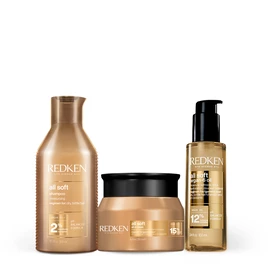
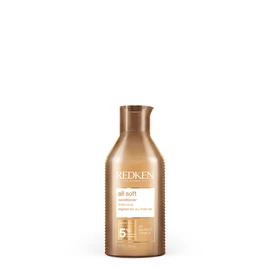
For unprocessed hair that is simply dry, the All Soft Shampoo is the better match.
How Often Should You Use Bonding Shampoo?
Bonding shampoo is designed for use at every wash while damage is active, because bond reinforcement is cumulative and depends on consistency rather than intensity.
This is the point most people get wrong. A bonding shampoo is not a weekly treatment held in reserve. It replaces your everyday cleanser for as long as the hair needs structural support, which for regularly colored hair is indefinitely.
Browse the full Acidic Bonding Concentrate collection to see how the formats fit together.
Run it as a system. The Acidic Bonding Concentrate Duo covers the wash and condition steps, and adding the Acidic Bonding Concentrate 5-Min Liquid Mask once a week compounds the effect on the most damaged sections.
Watch for the stiffness signal. If hair starts to feel rigid or snappy rather than flexible, that is protein and structure outpacing moisture. Keep the bonding cleanser and add a moisture mask rather than dropping back to a moisturizing shampoo, which would remove the structural support along with the stiffness.
Curls and coils follow the same logic with a different conditioner. The Acidic Bonding Curls Silicone-Free Conditioner pairs bond repair with avocado and camelina oils so reinforcement does not come at the cost of pattern and definition.
Bonding shampoo is worth it when your hair has structural damage, and largely wasted when it does not. Check elasticity, look at what you have done to the hair chemically and thermally, and match the cleanser to the actual problem. Get that right and the wash step stops being the weakest part of your routine and starts being the step that holds everything together.
When to Book a Professional Consultation
To find out whether your hair needs bond reinforcement, moisture, or both, schedule an appointment with a professional Redken hair stylist for a one-on-one consultation. Your stylist will assess porosity and elasticity in person and prescribe the cleanser and treatment plan matched to your hair’s condition and your color goals.
Find a Redken salon near you to book a stylist consultation.
Next: What Are Hair Bonds? The Secret to Strong, Resilient Hair. Break down the science of hair bonds, reveal what breaks those bonds, and how to repair and protect them like a pro.