In this article:
- What Makes Damaged Hair Look Shiny?
- Why Does Damaged Hair Look Dull?
- What Adds Shine to Damaged Hair?
- Do Shine Hair Styling Products and Hair Oils Work?
- When Is Dullness a Sign of Something a Product Cannot Fix?
Key Takeaways:
- A flat, aligned cuticle returns light in one direction and reads glossy, while a lifted or eroded one scatters it and reads dull.
- Damaged hair loses shine early because damage lands on the surface first: heat, lightening, brushing and hard water wear down the scales that do the reflecting.
- Acidic care that seals the cuticle, a cool finish to the wash, gentler drying and brushing, then a light oil or mist applied last.
- Shine sprays and oils work optically. They fill a rough surface with an even film, which looks convincing and washes out, so treat them as the finish and not as the fix.
- Hair with too little cuticle left needs repair, and often a cut, before it will hold a gloss, and a salon gloss service is a color service, not a conditioning one.
QUICK ANSWER
Shine is light bouncing off a smooth surface, so damaged hair looks dull because its raised cuticle scatters that light, and the products that help are the ones that flatten and seal the surface.
Shine is often the first thing damaged hair loses, and one of the easiest things to temporarily bring back. The difference comes down to what a product is actually changing, what it is simply smoothing over, and what damaged hair can realistically recover from.
What Makes Damaged Hair Look Shiny?
Hair looks shiny when its outer layer is smooth enough to send light back in one direction instead of scattering it in many, which makes shine a property of the surface of the strand and not a measure of how healthy the hair underneath is.
That outer layer is the cuticle, a sheath of overlapping scales lying along the strand like tiles on a roof. When the scales sit flat and aligned, the light landing on the strand leaves at a predictable angle. Stand a smooth blow-dry near a window and you can see the result: a bright band running across the hair where thousands of strands are all returning light the same way. Rough that surface up and the band breaks into countless small highlights pointing in different directions, which the eye reads as gray, flat and dull.
Three things shift the reading before damage enters the picture. Dark hair looks glossier than light hair because the highlight has more contrast to sit against. Coarse strands present a wider flat plane than fine ones. And texture matters most: straight hair offers a long continuous surface and produces one clear band, while curly and coily hair reflects from many small curved planes and reads as a soft overall sheen. That is a difference in optics, not a shortfall, and chasing a mirror finish on a curl pattern that was never going to give one is a reliable way to over-apply product.
Why Does Damaged Hair Look Dull?
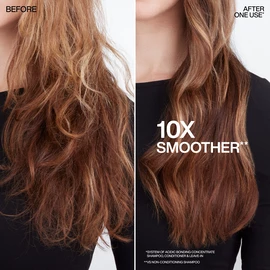
Damaged hair looks dull because damage reaches the surface first: heat, lightening, friction and hard water lift and erode the cuticle scales, and a broken surface scatters light instead of returning it as one clean reflection.
This is why dullness deserves attention. Shine is usually the earliest loss, arriving well before hair starts snapping or feeling rough. A strand can be perfectly strong and already scattering light.
The pattern is predictable. Ends dull before the rest, because they are the oldest hair on your head and have taken the most washes, brush strokes and passes of a hot tool. Lightened hair dulls faster than hair that has only had color deposited on it, since lifting works by wearing down the same outer layer that does the reflecting. And once the cuticle is raised, water moves in and out of the fiber quickly, so hair reads dry and dull at once.
Frizz dulls hair by the same optics, since strands standing away from the length break up the plane that would otherwise reflect as one, and What Causes Frizz: A Look at the Cuticle covers why the surface lifts in the first place.
Hard water creates a dullness that conditioning does not solve: minerals deposit on the strand and build a film that dulls and stiffens at once. One clarifying wash tells you whether that is your problem.
What Adds Shine to Damaged Hair?
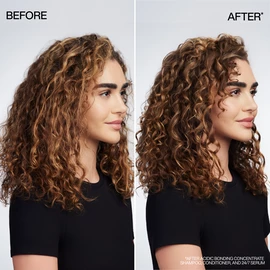
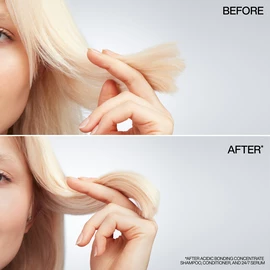
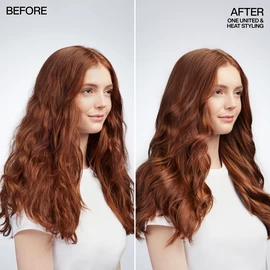
Shine comes back on damaged hair by improving the surface it reflects from, which means less mechanical wear, cooler and more controlled drying, and a light finishing product applied last.
- Seal the cuticle when you wash. This is the step that moves the baseline instead of the finish.
- Put a leave-in on damp hair. It provides protection against the drying and styling that roughens the surface again.
- Finish the wash cool. A cooler final rinse and a cool shot at the end of a blow-dry help the surface settle before the style sets, and it costs nothing to try.
- Change how you dry and brush. Squeeze water out with a microfiber towel instead of scrubbing, point the dryer nozzle down the length so the airflow runs with the scales, and detangle from the ends upward.
- Add the finishing layer last. An oil or a shine mist goes on after the style is set. Applied first it gets diluted and dragged around, applied last it does its whole job.
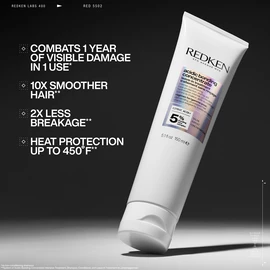
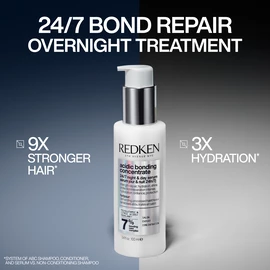
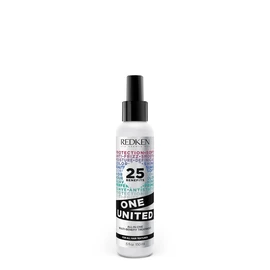
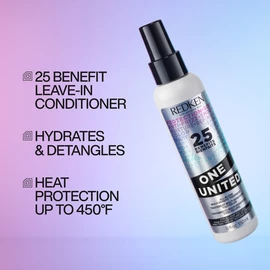
For the first two steps, try Acidic Bonding Concentrate Shampoo, built on Redken's Bonding Care Complex + Citric Acid, which works at a molecular level and penetrates the cuticle, capturing metal ions, reinforcing weakened bonds, and improving hair strength. Then One United Leave-In Conditioner, a lightweight leave-in that primes, protects and treats with lactic acid and coconut oil, goes on damp and helps prevent heat damage from hot tools.
Order matters more than product count. Every step before the last is about the surface itself, and the last is about how that surface photographs. Shine also responds faster than strength does, so it tends to be the first improvement you notice.
Do Shine Hair Styling Products and Hair Oils Work?
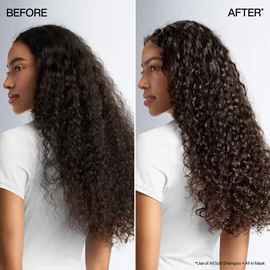
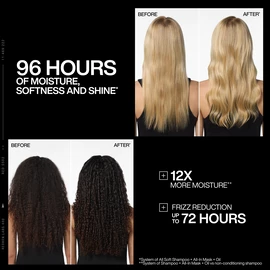
Yes, and it helps to know exactly what they are doing: an oil or a shine spray fills the microscopic roughness of a damaged surface with a thin, even film, so light leaves the strand as a band again instead of scattering off every raised edge.
The film sits on the outside of the strand and washes out, so the result is real while it lasts and gone at the next shampoo.
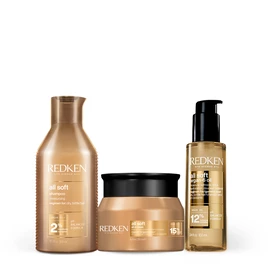
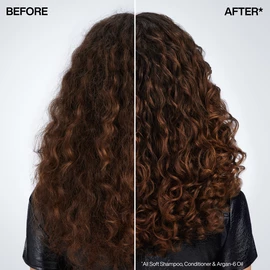
An oil does a little more than reflect. All Soft Argan-6 Oil is built on Argan Oil, which is high in antioxidants, essential fatty acids and vitamin E, and helps increase hair’s elasticity and restore shine to dull hair. Use it on mid-lengths and ends, damp before drying or dry as a finisher, and start with less than you think: warm a small amount between your palms and press it in instead of raking it through.
Spray Smooth is designed to smooth and control the finished look. Hold it well away from the head and lightly mist over the outer surface of the hair, focusing on areas that need additional smoothness. Avoid saturating the roots or applying too much product, which can leave hair looking heavy.
At-home shine versus a salon gloss
These are different categories, and the words get used interchangeably in a way that costs people money. A gloss or glaze in the salon is a color service: a professional applies a demi-permanent formula, clear or tinted, that deposits at the surface and lasts through several washes, so it adjusts tone as well as reflection. A shine spray cannot change tone, and a gloss is not a conditioning treatment.
When Is Dullness a Sign of Something a Product Cannot Fix?
Dullness has stopped being a product problem when there is not enough surface left to reflect, and the tell is simple: hair looks good only while a finishing product is sitting on it, then goes flat again the moment you wash.
Three signals point the same way, and they read most clearly on clean, dry, unstyled hair in daylight.
- The shine reads wet, not bright. If oil makes hair look damp and heavy instead of polished, the surface is too porous to hold an even film.
- The ends look pale and matte. Over-lightened or worn ends go slightly translucent in daylight and stay rough however you finish them.
- Product disappears overnight. Hair that soaks up everything you apply and is dull again by morning has lost cuticle, and lost cuticle does not grow back.
When that is the picture, the order of operations changes: repair the fiber and remove the failed length first, then think about gloss. A cut is often the faster half of the answer, because the hair that dulls worst is the hair with the least structure left in it.
None of this puts shine out of reach. It means shine follows condition. As the surface improves the reflection improves with it, and the products you already own start performing better on the same head of hair.
Shine is the most visible thing hair does and the least structural. It comes from a flat surface, it disappears when that surface is disturbed, and it returns in proportion to how much surface you restore. Treat sealing care and gentler handling as the work, treat oils and sprays as the finish, and the two together get most people most of the way there.
When to Book a Professional Consultation
Bring a stylist in when the dullness is uneven across the head, when the ends look and behave differently from the rest of the length, or when you are weighing a gloss service against buying another product. Those are judgments made by looking at dry hair under salon light, and they usually change what gets recommended.
Find a Redken salon near you to book a professional consultation.
NEXT: What’s Really Causing Your Hair to Break. Shine is usually the first thing to come back, and the first thing lost again if the damage behind it was never addressed. This piece covers the five categories of stress behind most damage, so the routine that’s working keeps working.