In this article:
- What Causes Hair Breakage?
- How Does Heat Styling Break Hair?
- Does Coloring Your Hair Cause Breakage?
- Can Brushing and Tying Your Hair Cause Breakage?
- How the Hair Fiber Can Affect Breakage
Key Takeaways:
- Breakage is a physical fracture along the length of a strand, which makes it a different problem from shedding, where a whole hair leaves at the root.
- The causes group into five categories: mechanical force, heat, chemical processing, environmental exposure and physiological factors. Most breaking hair is hit by more than one.
- Heat and chemistry compound each other, because a lightened or relaxed fiber has fewer intact bonds and the same blow-dry costs it more.
- Mechanical breakage is the most common and the most fixable, because hair is weakest when wet, which is exactly when most people brush, towel and tie it.
QUICK ANSWER
Hair breaks when the fiber’s protective cuticle and internal bonds are worn down faster than they can be maintained, usually by a combination of mechanical handling, heat, chemical processing and environmental exposure.
Hair breakage is often the result of repeated stress over time. Heat styling, brushing, detangling, and tight hairstyles can gradually weaken the hair fiber. By the time a strand breaks, the cause is often a pattern of repeated stress rather than a single event. Understanding those sources of stress is the first step toward reducing breakage.
What Causes Hair Breakage?
Hair breakage is the physical fracture of a strand somewhere along its length, and it happens whenever the force acting on the fiber is greater than the strength left in the cuticle and cortex holding it together.
Hair is built in layers. The cuticle is the outer sheath of overlapping scales that lies flat when hair is healthy and lifts when it is not. Underneath sits the cortex, the keratin bundle that carries almost all of the strand’s strength, held in shape by chemical bonds. Damage enough of that stack and it snaps. The stresses fall into five groups:
- Mechanical: brushing, detangling, tying, backcombing, towel rubbing and the constant friction of hair against fabric.
- Thermal: blow-dryers, flat irons, curling tools and any repeated heat that drives water out of the fiber.
- Chemical: permanent color, lightening, relaxers, perms and the mineral content of the water you wash in.
- Environmental: sun exposure, chlorinated pools and salt water, all of which roughen the cuticle and dehydrate the fiber over a summer.
- Physiological: nutrition, illness, medication and hormonal changes, which affect the hair while it is still being formed.
The first four are cumulative and they overlap, which is the part most people miss because hair cannot repair itself. A strand fracturing across its width, a breakage, is also a separate problem from an end splitting along its length, a split end.
How Does Heat Styling Break Hair?
Heat damage is the structural change that occurs when a hair fiber is taken past the temperature at which its internal water, lipids and keratin can stay stable, and it accumulates instead of resetting overnight.
Every hair holds a small amount of water inside the cortex, and that water helps keep the fiber flexible. Heat drives it out. When the heat is gradual, the fiber can recover much of that moisture from the air. But when a very hot tool is held in one place, the water turns to vapor quickly, putting pressure on the surrounding structure and creating weak points where the strand can later break.
Three habits do most of the harm:
- Styling hair that is still soaking wet, which puts the most water in the fiber at the moment the most heat arrives.
- Going over the same section repeatedly because the first pass did not hold, which multiplies the exposure without changing the result.
- Using the highest setting as a default rather than an exception, on fine or already processed hair that needs far less.
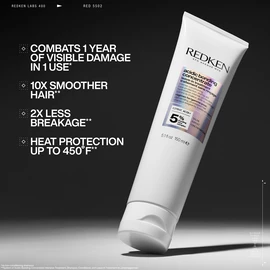
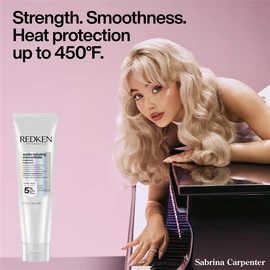
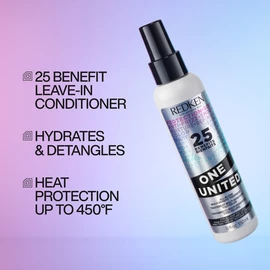
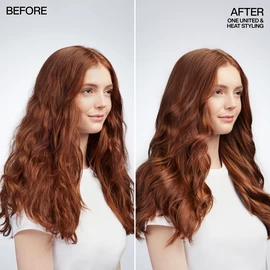
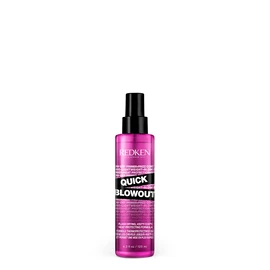
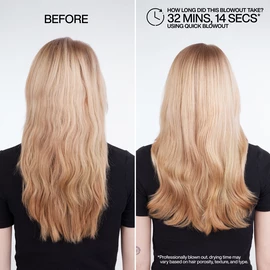
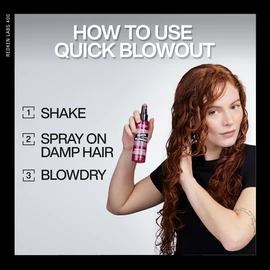
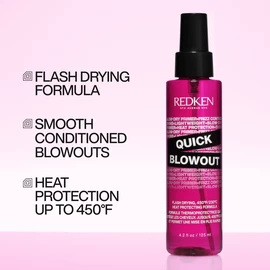
Heat damage responds to technique first, but the right product can help protect the hair you’re working to preserve. Before heat styling, use a heat protectant or styling primer designed to shield hair from heat and help create a smoother foundation for styling.
Does Coloring Your Hair Cause Breakage?
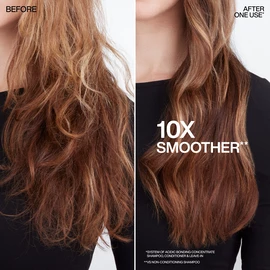
Yes. Coloring can make hair more prone to breakage because permanent color and lightening lift the cuticle and weaken some of the disulfide bonds—the strong chemical links that help hold the hair’s inner structure together. That loss of strength is known as chemical breakage, and the same type of damage can happen with relaxing and perming, too.
Permanent color raises the hair’s pH, making the cuticle swell and lift so dye precursors can get into the cortex. Lightening goes even further, breaking down natural pigment into smaller fragments while weakening more of the bonds that give the fiber its strength. Relaxers and perms work on those bonds deliberately. None of these services is automatically a problem, but repeated chemical processing can leave the hair progressively more fragile.
That shows up in three ways. Porosity rises permanently, so hair takes on water faster. Elasticity changes, so a wet strand can stretch differently before it fails. And the hair has less tolerance for other forms of stress, which is why a routine blow-dry can more easily snap a lightened strand.
Two multipliers can make things worse. Overlapping a service onto already processed lengths instead of just new growth means processing the same hair twice. And mineral-rich water can also leave calcium on the fiber, while copper and iron from plumbing or well water can build up on and inside it, potentially speeding up oxidation during the next chemical service.
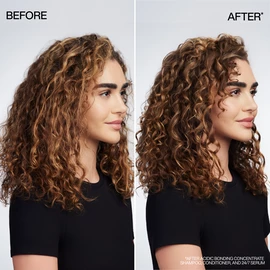
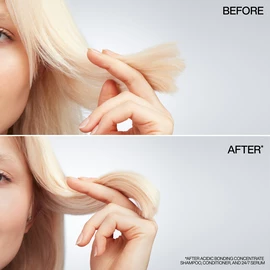
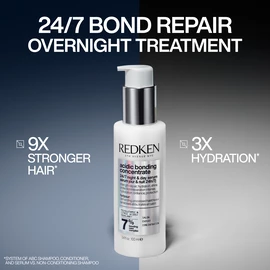
Hair in this category needs bond chemistry rather than conditioning alone, which is what Acidic Bonding Concentrate Shampoo is built for.
Can Brushing and Tying Your Hair Cause Breakage?
Yes. Mechanical breakage is damage caused by physical force on the hair, and brushing and tying are the two most common sources of it, alongside friction and abrasion from combs, elastics, fabrics and your own hands.
Hair is weakest when wet: a soaked strand has swollen and lost much of the strength it has when dry, and most brushing, towel rubbing and raking a comb from the roots down happens in exactly that window. The recurring offenders:
- Detangling from the top down, which drags every knot in the length into one growing tangle at the ends instead of releasing them.
- Tying in the same spot every day, which concentrates tension on one band of fiber until short broken pieces appear right where the elastic sits.
- Elastics with metal joins or rough seams, which abrade the cuticle every time they are pulled out.
- Friction while you sleep, as loose hair moves against a rough pillowcase for hours at a time.
- Everyday abrasion on long hair, where the oldest ends rub against collars, coats and bag straps and wear out before the rest of the strand does.
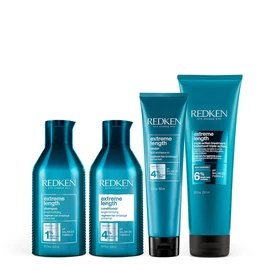
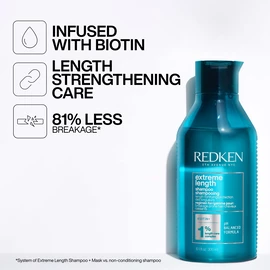
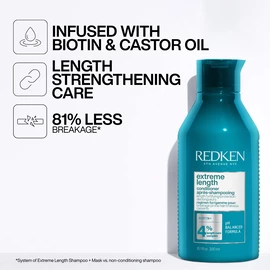
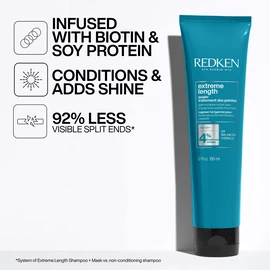
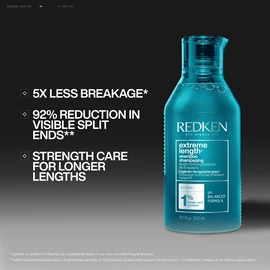
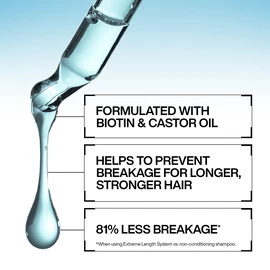
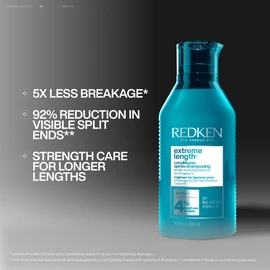
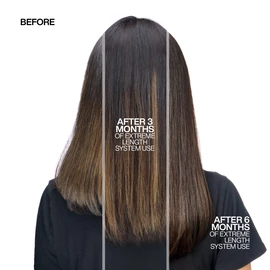
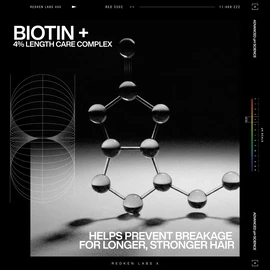
Mechanical wear is basic damage rather than bond damage. Extreme Length, made with Biotin, Castor Oil and Length Care Complex, helps fortify hair worn down by everyday handling.
How the Hair Fiber Can Affect Breakage
Hair is made primarily of keratin, a structural protein that gives the fiber its strength and resilience. Factors that affect the hair while it is forming can influence the quality of the strand before it even emerges from the scalp.
Once the hair grows out, the fiber is no longer living tissue, so it cannot rebuild itself. Repeated heat styling, chemical services, brushing, and other forms of mechanical stress can gradually weaken the protein structure and increase the risk of breakage along the strand.
Breakage Along the Strand Is Not the Same as Shedding From the Root. This distinction matters because the two problems start in different places. Breakage happens along the length of the hair, leaving shorter pieces of uneven length with a blunt or frayed end. Shedding happens at the follicle, when the entire strand naturally releases from the scalp and may have a small bulb at one end.
If you're seeing short, broken pieces, the issue is likely somewhere along the length of the hair, where your routine, styling habits and chemical services can make a difference. If you're finding whole hairs with bulbs, especially if the change followed an illness, new medication or major life event, it's worth talking with a doctor or trichologist to understand what's happening at the scalp.
When to Book a Professional Consultation
If your own history does not point clearly at one cause, book an appointment with a professional Redken hair stylist for a one-on-one consultation. Someone with your hair in their hands can see where along the length it is failing, work backward through the services and tools that came before it, and say plainly when the answer belongs with a doctor.
Find a Redken salon near you to book a professional consultation.
NEXT: Hair Damage: A Severity Scale From Mild to Severe. Knowing why hair breaks is half the picture. The other half is how far along your own hair actually is. This severity scale walks through two at-home tests that place your hair on that scale, so you know whether you’re looking at a routine fix or a haircut.